
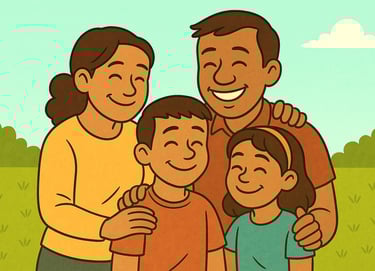
Day 17 - they look out for each other.
The Alvarez siblings used to fight about everything—snacks, toys, attention, even who got to close the car door.
Their parents brushed it off as “normal sibling stuff,” until something happened that revealed a deeper issue.
One afternoon at school, 8-year-old Marco slipped on the playground and scraped his knee.
His older sister, Clara, saw it happen… but hesitated.
She didn’t rush to him. She didn’t offer help. She looked away, unsure if he even wanted her support.
That night, Marco whispered to his mom,
“Clara didn’t come when I fell. I thought she didn’t care.”
It wasn’t just a scraped knee.
It was a sign that the children weren’t seeing themselves as protectors of one another — just individuals sharing a home.
If left unaddressed, this would grow into emotional distance: siblings becoming competitors instead of allies, family members shutting down rather than stepping in.
The turning point came when their parents gathered them and said,
“In this family, we look out for each other. We don’t leave anyone hurting or alone.”
It was simple. Clear. Transformative.
Slowly, the children began to show up for one another — in small but meaningful ways.
💡Family psychology research consistently shows that children who feel emotionally protected and supported by family members develop stronger resilience, better peer relationships, and higher emotional intelligence.
Studies from the University of Wisconsin, the APA, and family resilience research highlight:
1. Noticing. When family members actively notice one another’s emotions and needs, studies show it strengthens emotional safety and reduces anxiety.
2. Supporting. Consistent support from siblings and parents improves resilience, teaches healthy coping skills, and reduces the likelihood of emotional withdrawal.
3. Shielding. Knowing that someone will “stand with you” — emotionally or physically — builds long-term confidence, trust, and relational closeness.
WHICH PRACTICAL STEP CAN YOUR FAMILY APPLY FIRST?
Create a simple Family Phrase: “We don’t leave someone struggling alone.”
Teach siblings or family members to check on each other once a day: “How’s your heart? Need anything?”
Start a “Help Before You’re Asked” habit — if you see a need, step in.
Encourage each family member to pray for one person in the home every day.
Assign “support buddies” for tasks, school assignments, or emotional check-ins.
Support is not a personality trait —
it is a habit you build into the culture of your home.
Small, shared joys bring families together again.
“Lord, thank You for giving our family to one another as a gift.
Teach us to see each other’s needs with compassion and wisdom.
Open our eyes to moments when we can support, protect, and encourage.
Help us respond quickly when someone is hurting or overwhelmed.
Grow in us a spirit of unity that stands strong in every season.
Remove selfishness, indifference, and hesitation from our hearts.
Fill our home with empathy, kindness, and gentle strength.
Show us how to pray for one another with intention and love.
We ask for Your covering over each member of our family.
Make us a family who looks out for each other the way You look out for us.”
Prayer
Note: Choose one and list it in your notebook; each day, we will add a declaration for your family.
You may also create your own one-liner each day. Remember, words create worlds.
We look out for each other with love and devotion. (Romans 12:10)
We stand together in every season. (Ecclesiastes 4:12)
We choose compassion over indifference. (Colossians 3:12)
We protect one another with gentleness and strength. (Psalm 133:1)
We become a refuge for each other’s hearts. (Proverbs 17:17)