
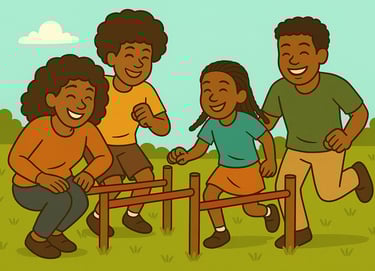
Day 20 - They approach problems with courage and creativity.
It felt unusually quiet after an unexpected power outage shut everything down on a stormy afternoon.
The kids panicked when the lights flickered off, and Mom felt her own anxiety rise as the wind howled outside.
Dad rushed from room to room trying to find flashlights, muttering in frustration, while the children watched his agitation grow.
The tension escalated when their youngest asked, “What are we going to do?” and no one had an answer.
For a moment, fear filled the house more loudly than the storm.
Dad finally gathered the family in the living room, but by then everyone already felt unsettled—
eyes darting,
hearts racing,
and imaginations spiraling.
The problem wasn’t the outage; it was how unprepared and reactive they all felt. Instead of teamwork, panic had taken over, and no one knew how to calm the atmosphere.
What could have been a simple challenge became a moment of emotional unraveling. If left unaddressed, three things happen:
1. Children begin to view problems as threats instead of puzzles they can solve.
2. Parents become reactive rather than steady leaders in stressful moments.
3. The home becomes a place of tension rather than a refuge when challenges arise.
“Be strong and of good courage; do not be afraid, nor be dismayed, for the Lord your God is with you wherever you go.” — Joshua 1:9
God’s instruction to Joshua wasn’t simply about bravery—it was an invitation to face uncertainty with divine companionship.
Courage is not the absence of fear; it is the decision to trust God’s presence more than the pressure of the moment. Families who approach challenges with calmness model the very posture God asks His people to hold.
When parents steady their hearts, children learn that problems are not giants—they are opportunities to see God’s help in action.
This verse reminds us that courage is rooted in relationship, not personality. God commands courage because He supplies the strength to carry it out.
Creativity also thrives when fear is quieted; solutions emerge when hearts are steady.
When families face challenges together, they reflect the unity and faith God desires for His people. Every obstacle becomes a training ground where courage deepens, creativity grows, and God’s presence becomes unmistakably real.
💡Research shows that children develop stronger problem-solving skills when parents model calm responses.
A study from the University of Rochester found that parental emotional regulation directly influences a child’s ability to stay composed during challenges.
Another study published in Child Development revealed that children who engage in collaborative problem-solving with parents develop higher resilience and better executive function.
They say, fear-based responses activate the amygdala, narrowing the brain’s capacity for creative thinking, while calm guidance increases prefrontal cortex activity—promoting creativity and flexible thinking.
Families who approach problems with curiosity instead of panic actually strengthen neural pathways related to innovation.
Creativity grows in environments where mistakes are explored rather than punished.
Courage increases when children repeatedly experience safety during problem-solving moments.
When parents remain steady, children perceive obstacles as manageable rather than overwhelming. Over time, this shapes a family culture where challenges become invitations rather than threats.
Calming: Regulate emotions first to reduce fear and widen perspective.
Clarifying: Identify the real problem without panic or blame.
Creating: Explore multiple solutions with openness and teamwork.
WHICH PRACTICAL STEP CAN YOUR FAMILY APPLY FIRST?
Practice “Pause–Breathe–Plan.”
Before responding to any challenge, pause for 3 seconds, take a slow breath, and invite the family to plan together.
Introduce “Family Problem-Solving Huddles.”
Sit together when an issue arises and brainstorm three possible solutions without judging any idea.
Use “What Else Could Work?” language.
This phrase encourages creativity and reduces defeatist thinking during stressful moments.
Try “Courage Drills.”
Once a week, attempt a small, slightly challenging task together—fixing something broken, navigating a new place, or learning a new skill.
Engage in outdoor activities that build collaborative courage.
Obstacle courses, nature scavenger hunts, backyard challenges, or cooperative games that require balancing, lifting, or team strategy—all help children learn confidence while solving problems physically.
Small, shared joys bring families together again.
Father, thank You for being our steady help in every challenge and for guiding our family through difficult moments.
We confess that we often react with fear, frustration, or anxiety, and we repent for the times we forget to trust You first.
Cleanse our hearts and renew our responses so our home reflects Your peace.
Today we claim Your promise in Joshua 1:9—that You are with us wherever we go, giving us courage and strength.
Help us apply this truth by pausing, praying, and seeking solutions with calm hearts.
Teach us to approach problems with clarity and creativity instead of panic.
Give us wisdom for decisions, unity in challenges, and grace for one another.
Strengthen our courage and guide us through every situation we face.
Amen.
Prayer
Note: Choose one and list it in your notebook; each day, we will add a declaration for your family.
You may also create your own one-liner each day. Remember, words create worlds.
We face challenges with steady hearts and courageous faith. (Deuteronomy 31:6)
We explore solutions together with creativity and hope. (Proverbs 24:5)
We respond to problems calmly, trusting God’s wisdom. (James 1:5)
We choose courage over fear in every situation. (Psalm 56:3)
We believe God equips us for every challenge we encounter. (2 Peter 1:3)