
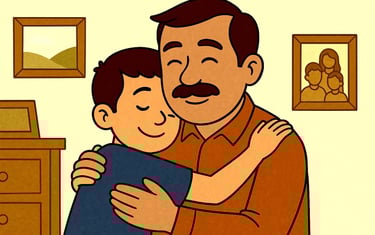
Day 19 - They celebrate each other—big and small wins.
The day had been long in the Santos household—everyone felt it. Mom rushed from meeting to meeting, Dad came home exhausted, and the kids kept their distance, sensing the heaviness.
No one was angry, but no one was connected either.
When their youngest, Lia, quietly tugged on her mom’s shirt for a hug, Mom—distracted and overwhelmed—responded with a quick pat on the shoulder before walking off to finish chores.
Lia stood frozen, unsure whether she had done something wrong.
Later that night, their eldest, Caleb, retreated to his room after a frustrating day at school, hoping for a moment of closeness. But Dad, drained and preoccupied, simply said, “You’ll be okay,” without looking up from his phone.
Caleb closed his door gently, hiding the sting behind a practiced smile.
Meanwhile, the house grew quieter—not peacefully, but hollow, as if affection had slowly leaked out of the walls.
Everyone loved each other deeply, but affection had become an afterthought, replaced by busyness, fatigue, and silence. If left unaddressed, three things begin to crumble:
1. Emotional distance grows even in a home filled with people.
2. Children misinterpret lack of affection as lack of love.
3. The family bond weakens, making conflicts sharper and comfort harder to give.
“Let all that you do be done in love.” — 1 Corinthians 16:14
This verse is simple, yet it rebuilds the foundation of a home when practiced daily. Love is not merely emotion—it is action.
God calls families to express love in tangible ways, not just in spoken belief.
Affection is one of the gentlest forms of love made visible.
When a home is filled with warm gestures, soft tones, and genuine presence, it becomes a living reflection of God’s heart.
Jesus Himself showed affection—touching the sick, blessing children, and comforting the hurting.
Love that is expressed physically and verbally makes relationships secure, especially for children whose emotional world is shaped by what they feel and hear.
When affection flows freely, fear loses its grip and connection becomes natural again.
In every gentle touch and every kind word, families practice the very thing God commands: love lived out loud.
💡Studies show that affectionate touch plays a significant role in emotional and physical well-being.
Research from the University of Notre Dame found that children who received consistent affection grew into adults with lower anxiety and higher emotional resilience.
Physical affection activates the parasympathetic nervous system, calming stress responses and stabilizing mood.
Neuroscientists at UCLA discovered that affectionate touch releases oxytocin, the bonding hormone that strengthens trust and connection.
Affection also helps regulate a child’s heart rate and reduces cortisol, the body’s primary stress hormone. Even brief moments—like a hug or a gentle hand on the shoulder—can shift the brain toward safety and connection.
Families who express love through physical and verbal affection build stronger relational security over time. These habits shape a child’s internal world long into adulthood. Affection, scientifically and emotionally, is one of the most protective forces inside the home.
Holding: Affectionate touch communicates safety and belonging.
Hearing: Gentle words deepen emotional understanding and trust.
Healing: Affection strengthens resilience and soothes stress responses.
WHICH PRACTICAL STEP CAN YOUR FAMILY APPLY FIRST?
Use a “Daily 8-Second Hug.”
Longer hugs help regulate the nervous system and strengthen emotional connection. Give one in the morning and another before bed.
Start a “Warm Words Jar.”
Each family member writes a simple affirmation for someone in the home throughout the week. Read them together every weekend.
“Gentle Presence Moments.”
Place a reassuring hand on your child’s back while they talk, offer a shoulder squeeze during homework, or give spontaneous side-hugs throughout the day.
Create a “Cuddle Time Ritual.”
Pick a consistent time—before school, after dinner, or before bedtime—where you cuddle on the couch or snuggle quietly on the bed for a few minutes. This gives children the physical reassurance they often need but struggle to ask for.
Introduce “Outdoor Affection Games.”
Choose outdoor play that naturally involves tumbling, hugging, and close contact:
Bear Hug Tag (you tag by hugging)
Rolling Races on the grass
Parent vs. Kids Gentle Tumble Play
“Catch & Hug” sprint games
These playful movements build connection, trust, and loads of laughter.
Small, shared joys bring families together again.
Father, fill our home with affection that reflects Your love.
Teach us to slow down and offer warmth through gentle words and caring touch.
Help us express love freely, without holding back or letting stress harden our hearts.
Let our affection bring comfort on hard days and celebration on good ones.
May our home become a place where each person feels deeply valued, known, and embraced.
Lord, make tenderness the language of our family and let every expression of love point back to You.
Amen.
Prayer
Note: Choose one and list it in your notebook; each day, we will add a declaration for your family.
You may also create your own one-liner each day. Remember, words create worlds.
We express love generously and without hesitation. (1 John 4:7)
We offer warm words and gentle gestures that build each other up. (Ephesians 4:29)
We create a home where affection is freely given and deeply received. (Romans 12:10)
We comfort one another with presence, not pressure. (2 Corinthians 1:3–4)
We practice love as an active, daily choice. (Galatians 5:6)